
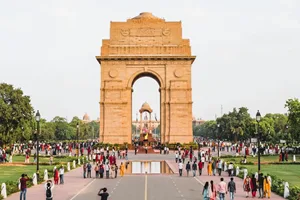
India Gate stands as one of New Delhi's most iconic landmarks and a powerful symbol of remembrance. Located at the eastern end of Kartavya Path (formerly Rajpath), this 42-metre-high sandstone arch commemorates the soldiers of the British Indian Army who died in the First World War and the Third Anglo-Afghan War. Today it serves both as a solemn war memorial and a vibrant public space at the heart of India's capital.
Historical Background
In the aftermath of the First World War, the Imperial War Graves Commission (later the Commonwealth War Graves Commission) sought to honor the contributions of soldiers from across the British Empire. Nearly 70,000 to over 80,000 soldiers from undivided India lost their lives between 1914 and 1921, fighting in theatres that included France and Flanders, Mesopotamia, Persia, East Africa, Gallipoli, and the North-West Frontiers, as well as during the Third Anglo-Afghan War of 1919.
The memorial, originally named the All India War Memorial, was designed by the British architect Sir Edwin Lutyens, the principal planner of New Delhi. The foundation stone was laid on 10 February 1921 by the Duke of Connaught in a formal military ceremony. Construction took a decade; the monument was completed and inaugurated on 12 February 1931 by Viceroy Lord Irwin, coinciding with the formal dedication of New Delhi as the capital of British India.
After Independence in 1947, India Gate evolved into a national symbol. In January 1972, following India's victory in the 1971 Indo-Pakistani War (which led to the creation of Bangladesh), Primer Minister Indira Gandhi inaugurated the Amar Jawan Jyoti ("Flame of the Immortal Soldier") beneath the arch. This eternal flame, accompanied by an inverted rifle crowned with a soldier's helmet, paid tribute to the unknown soldier's helmet, paid tribute to the unknown soldier and those who died in the 1971 conflict.
In 2019, the National War Memorial was inaugurated nearby at the C-Hexagon. On 21 January 2022, the Amar Jawan Jyoti flame was merged with the eternal flame at the new National War Memorial, consolidating post-Independence commemorations while preserving India Gate's original purpose.
Architecture and Design
Lutyens designed India Gate in a classical triumphal-arch style, drawing inspiration from Roman monuments such as the Arch of Constantine and from European war memorials including the Arc de Triomphe in Paris. He deliberately avoided Asian or religious motifs, favoring elemental simplicity and universal architectural language free of ornamentation that might divide communities.
The structure rises 42 metres (approximately 138 feet) and features a main arch spanning about 9.1 metres. It is built primarily of Bharatpur sandstone - a fine-grained, cream-to-red stone from Rajasthan, chosen for it's durability and ability to hold precise inscriptions. The arch stands on a low base of red Bharatpur stone and rises to a broad cornice. Both faces of the arch are inscribed with the word "INDIA," flanked by the Roman numerals MCMXIV (1914) and MCMXIX (1919). A shallow domed bowl on the rooftop was intended to hold flaming oil on ceremonial occasions, though this practice has rarely been observed in modern times.
Approximately 13,300 to 13,516 names of soldiers (predominantly India, with some British officers) whose graves could not be individually marked are carved into the stone surfaces. A formal dedication inscription above the archway honors those who fell in the various theatres of war and on the North-West Frontier.
The monument sits within a large hexagonal complex that forms part of Lutyens' grand axial plan for New Delhi, aligned with Rashtrapati Bhavan (the President's House) at the western end of Kartavya Path.
Significance and National Role
India Gate embodies both colonial-era remembrance and post-Independence national identity. It honors the shared sacrifice of soldiers from undivided India while serving as a focal point for contemporary military tributes. The Republic Day parade on 26 January traditionally passes along Kartavya Path and near India Gate, and the Prime Minister lays a wreath at the site of national remembrance as part of the day's ceremonies.
The surrounding lawns have long functioned as one of Delhi's most democratic public spaces-popular with families, joggers, tourists, and street vendors. At night the monument is floodlit, creating a striking golden spectacle against the Delhi sky. The nearby National War Memorial expands the site's role, commemorating more than 26,000 Indian Armed Forces personnel who have died in conflicts since 1947.
Visiting India Gate
India Gate is open 24 hours a day, seven days a week, with free entry and no tickets required. The best times to visit are early morning (for quitter surroundings and soft light) or late afternoon through evening (for the golden-hour glow on the sandstone and the illumination, typically from around 7:00 pm to 9:30pm). October to March offers the most pleasant weather; summers can be extremely hot, so early or late visits are advisable.
The Nearest metro stations are Central Secretariat (Yellow and Violet Lines) and, somewhat farther, stations on other lines; a short walk or auto-rickshaw ride completes the journey. Parking is limited, so public transport or cabs are recommended. Security is present, particularly during national events, and access arrangements can change around Republic Day.
Visitors can stroll the lawns, view the inscriptions (though close access to the arch itself may be restricted at times for security), enjoy street food from nearby vendors, and combine the stop with the National War Memorial a short distance away. Photography for personal use is generally permitted in the public ares.
Cultural and Enduring Legacy
More than a static monument, India Gate is woven into the daily and ceremonial life of New Delhi. It appears in countless photographs, films, and public gatherings. Its classical form, inscribed names, and central location continually remind observers of the human cost of conflict and the continuity of national memory - from the soldiers of the early 20th century to those who serve today.
In it's quiet dignity and open accessibility, India Gate remains both a place of solemn reflection and a living civic space, bridging India's past and present at the heart of the capital.
Comments
0