





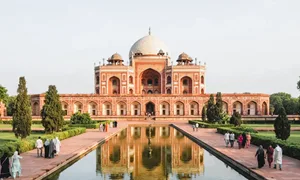
Commissioned in the 1560s and completed around 1572, the tomb remains a highlight of Delhi's rich Mughal heritage and a peaceful escape amid the bustling capital.
A Brief History
Emperor Humayun (1508-1556), son of Babar and Father of Akhar the Great, faced a turbulent reign marked by exile and reconquest. He died in 1556 after falling down the steps of his library at the Purana Qila in Delhi. His chief consort and widow, Empress Bega Begum (also mausoleum in his memory during the early years of Akhar's rule. Construction began around 1565 and was finished by about 1572 at a cost of roughly 1.5 million rupees. The Persian architect Mirak Mirza Ghiyas (sometimes spelled Ghiyath), assisted by his son Sayyid Muhammad, designed the structure. Persian and Indian craftsmen collaborated on the project. The site was deliberately chosen near the dargah (shrine) of the revered 14th-century Sufi saint Hazrat Nizamuddin Auliya, as burial near a saint's resting place was considered auspicious. Over time, the complex became known as the "dormitory of the Mughals," housing the graves of more than 150 members of the imperial family, including Bega Begum herself, various princes, and later figures such as Dara Shikoh. In 1857, the last Mughal emperor, Bahadur Shah Zafar, sought refuse here during the Indian Rebellion before being captured by British forces.
The tomb was inscribed as a UNESCO World Heritage Site in 1993 for its outstanding universal value as the first garden-tomb of its scale on the subcontinent and its profound influence on later Mughal architecture.
Architectural and Significance
Humayun's Tomb pioneered several features that defined Mughal imperial architecture. It sits at the exact centre of a formal charbagh (four-part paradise garden) inspired by Persian descriptions of the gardens of paradise in the Quran. The roughly 30-acre (about 12-hectare) garden is divided into quadrants by walkways and water channels that once flowed with water, creating a sense of ordered beauty and spiritual symbolism.
The mausoleum itself rises form a high terraced platform (about 7 metres tall) clad in red sandstone with white and black marble inlay. The main structure follows the harsht bihisht ("eight paradises") plan - a nine-fold layout with a central octagonal chamber surrounded by eight subsidiary rooms. its defining feature is the elegant white marble double dome (outer dome of exterior grandeur, inner dome (outer dome for exterior grandeur, inner dome for interior proportions), one of the earliest and most successful uses of this Persian technique in India. The dome reaches a height of around 42.5-47 metres and is topped by a brass finial. Chhatris (small domed kiosks), arched iwans (vaulted halls), and intricate latticework further enrich the design.
These innovations - monumental scale, the double dome, the charbagh setting, and the balanced use of red sandstone with white marble - directly inspired later masterpieces, most famously the Taj Mahal, built about 70-80 years later. The complex also includes several other contemporary tombs and structures, such as Isa Khan's Tomb (an earlier octagonal mausoleum), Nila Gumbad, Bu Halima's Tomb, Afsarwala Tomb, the Barber's Tomb, and the Arab Serai (once housing the craftsmen).
Extensive restoration work, notably by the Aga Khan Trust for Culture in partnership with the Archaeological Survey of India (ASI), has revived the gardens, water channels, and surrounding monuments, enhancing the site's authenticity and visitor experience.
Visiting Guide
- Location : Mathura Road, Nizamuddin East, New Delhi 110013. The complex lies opposite the Nizamuddin Dargah area.
- Timings : Open daily from sunrise to sunset (approximately 6:00 AM to 6:00 PM, with slight seasonal variation). Last entry is typically 30 minutes before closing. There is no weekly holiday. Note that some extended evening access or special events may occasionally be available-check current details before visiting.
- Entry Fees : (approximate current rates as of recent 2025-26 information; subject t change) Rs 35-40 (online rates sometimes lower than counter) for Indian nationals / SAARC / BIMSTEC citizens, Rs 550-600 for Foreign nationals. Entry is free for children under 15 years of Age.
Tickets can be purchased at the counter or preferably online via the official ASI e-ticketing portal to avoid queues. Personal photography is generally free; professional equipment or drones may require prior permission. An audio guide is sometimes available for a small additional fee.
Always verify the latest fees and rules on the ASI website or at the ticket counter, as rates can be revised.
How to Reach
- Metro (recommended): Nearest station is JLN Stadium (Jawaharlal Nehru Stadium) on the Violet Line. From there it is about 1.5-2 km - walk (15-25 minutes) or take a short auto-rickshaw ride (30-60). Jangpura station is another nearby option.
- By road/taxi/cab: Easily accessible via Mathura Road. Use ride-hailing apps (Uber/Ola) or taxis; parking is available near the entrance (paid).
- Train : Hazrat Nizamuddin Railway Station is only a few kilometers away.
- Bus : Local DTC buses stop in the Nizamuddin area.
October to March offers the most pleasant weather (cooler temperatures ideal for exploring the large grounds). Early morning (soon after opening) provides soft light, fewer crowds, and cooler air - perfect for photography. Late afternoon/golden hour is also excellent for the warm glow on the red sandstone. Avoid midday in the hot summer months (April-June). Weekdays are generally quieter than weekends.
Suggested Duration
1.5 to 2.5 hours for the main tomb, gardens, and key subsidiary structures. Allow more time if combining with the adjacent Sunder Nursery or the Humayun's Tomb World Heritage Site Museum.
Practical Tips
- Wear comfortable walking shoes - the complex is expansive with pathways and lawns.
- Carry water, sunscreen, a hat, and an umbrella (limited shade in open garden areas).
- Dress modestly out of respect for the historic and nearby religious sites.
- The complex is relatively accessible, though some older structures have steps.
- Guides (official or licensed) can enrich the visit with historical context.
- Combine your trip with nearby Sunder Nursery ( a beautifully restored heritage park with its own entry fee, open longer hours) and the relatively new underground Humayun's Tomb World Heritage Site Museum (separate timings and tickets; closed Mondays), which explores the broader Nizamuddin heritage. Joint or combo tickets may sometimes be available.
Nearby Attractions
- Hazrat Nizamuddin Dargah (Sufi shrine, short walk)
- Sunder Nursery
- Purana Qila (Old Fort)
- India Gate and Lodhi Garden (short drive)
- National Zoological Park
Humayun's Tomb offers more than architectural splendor - it provides a window into the evolution of Mughal aesthetics, it provides a window into the evolution of Mughal aesthetics, the devotion of a queen and the layered history of Delhi. Its peaceful gardens and harmonious proportions invite quiet reflection as much as admiration. Whether you are a first time visitor to India or a returning history enthusiast, this UNESCO site rewards unhurried exploration and remains one of Delhi's most rewarding heritage experiences. Plan ahead, arrive early, and let the red sandstone and white marble tell their story of paradise on earth.
Comments
0