







Historical Origins
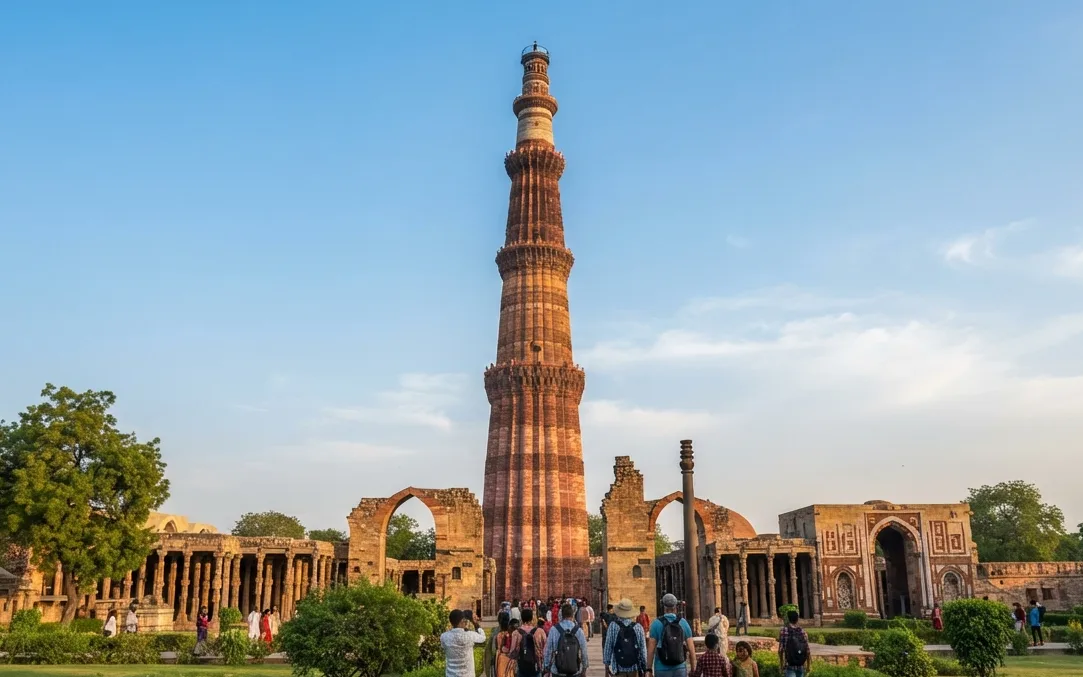
The construction of the Qutub Minar began around 1199 CE under Qutb-ud-din Aibak, the founder of Mamluk (Slave) dynasty and the first Sultan of Delhi. Aibak, a former general of Muhammad of Ghor, started the tower after the Ghurid victory over the Rajput king Prithviraj Chauhan in the Second Battle of Tarain in 1192. The minaret served dual purposes; it was a victory tower celebrating the establishment of Muslim rule in northern India, and a functional structure from which the muezzin could call the faithful to prayer at the nearby Quwwat-ul-Islam Mosque.
Aibak managed to complete only the first storey before his death. His successor and son-in-law, Shams-ud-din Iltutmish, added the next three storeys, completing the essential form of the tower by about 1220. In 1368, lightning struck the upper portion and caused significant damage. Firuz Shah Tughlaq repaired the structure, rebuilt the top sections, and introduced white marble, giving the upper storeys their distinctive appearance. Subsequent earthquakes in 1505 and 1803 let to further repairs under Sikandar Lodi and British officers. A cupola added by Major Robert Smith in 1828 was later removed and still stands in the complex, known as "Smith's Folly."
The name "Qutub Minar" is associated both with Qutb-ud-din Aibak and with teh revered Sufi saint Khwaja Qutbuddin Bakhtiar Kaki, who was held in high regard by Iltutmish.
Architectural Features
The Qutub Minar is a five-storeyed tapering tower made primarily of red and buff sandstone, with marble used in the upper levels. It has a base diameter of approximately 14.3 metres that narrows to about 2.7 metres at the top. A spiral staircase of 379 steps runs inside the structure (climbing beyond the lower levels is no longer permitted for safety reasons).
Each storey is marked by a projecting balcony supported on intricate muqarnas (honeycomb-like) corbels. The lower three storeys feature alternating angular and rounded fluting, while the upper two display a combination of marble and sandstone. Horizontal bands of Arabic calligraphy containing Quranic verses, along with geometric and floral designs, decorate the exterior. These inscriptions also record the successive phases of construction and restoration, turning the monument into a historical chronicle in stone.
The design was clearly inspired by the Minaret of Jam in Afghanistan, reflecting the Central Asian architectural traditions that the Ghurid rulers brought to the Indian subcontinent. At the same time, the use of local materials and craftsmanship marks the beginning of a distinctive Indo-Islamic style.
The Qutb Complex
The Qutub Minar does not stand alone. It forms the heart of a rich archaeological complex that reveals successive layers of Delhi's history:
- Quwwat-ul-Islam Mosque ("Might of Islam") - One of the earliest mosques built in Delhi after the Islamic conquest. An inscription records that it was constructed using materials from 27 demolished Hindu and Jain temples. Reused columns and lintels still display earlier carvings.
- Iran Pillar of Delhi - A remarkable 7-metre wrought-iron pillar dating to the Gupta period (early 5th century CE). Famous for its extraordinary resistance as a testament to ancient Indian metallurgical skill.
- Alai Darwaza - Built by Alauddin Khalji in 1311, this ceremonial gateway is the first structure in India to employ true arches and a true dome in the Indo-Islamic manner.
- Alai Minar - An unfinished tower begun by Alauddin Khalji, intended to be twice the height of the Qutub Minar. Only the massive first storey remains.
- Other important structures include the tomb of Iltutmish and remains of a madrasa.
Together these monuments illustrate the political ambition, religious transformation, and architectural evolution of the early Delhi Sultanate.
Cultural and Historical Significance
The Qutub Minar complex is an outstanding example of the architectural and artistic achievements that followed the establishment of Islamic rule in northern India. It represents the introduction of new building types - minarets, true arches, and domes - while also showing how local materials, techniques, and even architectural fragments were incorporated into the new style.
As a UNESCO World Heritage Site, the complex is recognized for its outstanding universal value as a testimony to the cultural and political changes of the 12th and 13th centuries. It remains one of Delhi's most visited heritage destinations and a powerful symbol of the city's multi-layered past.
Visiting the Monument
Located in Mehraulli, South Delhi, the Qutub Minar complex is easily accessible and open to visitors during daylight hours. The site is maintained by the Archaeological Survey of India. Visitors can walk around the complex, admire the intricate carvings, and view the Iron Pillar and other structure at close range. Climbing the minaret itself is restricted for conservation and safety reasons.
Whether viewed from a distance or explored on foot the Qutub Minar continues to impress with its soaring height, refined proportions, and deep historical resonance. More than eight centuries after its foundation was laid, it still stands as a proud and enduring landmark of Delhi's rich and complex heritage.
How to Visit Qutub Minar
- Location - Qutub Minar Complex, Mehrauli, New Delhi - 110030
- Opening Hours - The complex is open daily from sunrise to 8:00 PM (typically around 7:00 AM to 8:00 PM). Last entry is usually 30-45 minutes before closing. It remains open all days of the week, including public holidays (subject to occasional temporary restrictions for maintenance or special events).
- Entry Fees (as per Archaeological Survey of India) - Rs 35 (online) / Rs 50 (cash at counter) for Indian citizens SAARC & BIMSTEC nationals and Rs 550 (online) / Rs 600 (cash at counter) for Foreign tourists, Free entry for Children below 15 years.
Tickets can be purchased online through the official ASI portal or at the ticket counters near the entrance. Online booking is recommended to avoid queues. Carry a valid photo ID.
How to Reach
- By Metro (most convenient) : Take the Yellow Line to Qutub Minar Metro Station. From the station it is approximately1-2 km; a short walk or a quick autor-rickshaw / e-rickshaw ride (Rs 20-50) takes you to the entrance.
- By Cab/Auto : Readily available via Uber, Ola or local taxis, From Connaught Place it takes about 30-40 minutes; from Indira Gandhi International Airport it is roughly 20-30 minutes (about 11-12 km).
- By Bus : Several DTC buses stop near the complex./




Comments
0