



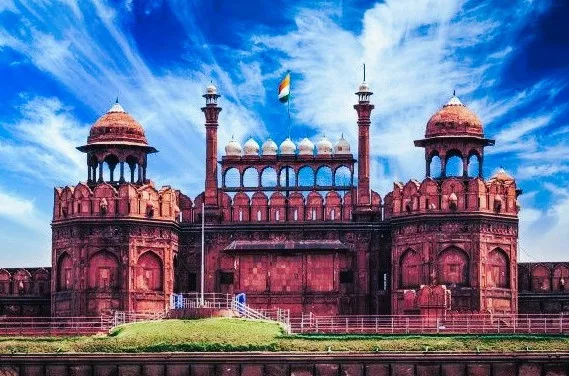
Commissioned by Emperor Shah Jahan, it served as the main residence of Mughal emperors for nearly two centuries and remains a powerful national symbol where the Indian Prime Minister hoists the national flag every Independence Day.
History
Emperor Shah Jahan, the fifth Mughal ruler and the "Architect King," decided to shift the Mughal capital from Agra to Delhi in the late 1630s. He found a new city called Shahjahanabad (present-day Old Delhi) and commissioned the Red Fort as its citadel and royal residence. Construction began around 1638-1639 (with the foundation laid in May 1639 according to many accounts) and was completed in 1648.
The chief architects were Ustad Ahmad Lahori (also associated with the Taj Mahal) and Ustad Hamid. The fort was originally known as Qila-i-Mubarak ("the Blessed Fort").
It remained the seat of Mughal power until 1857. The fort witnessed the empire's peak under Shah Jahan and Aurangzeb, followed by gradual decline. In 1739, Persian invader Nadir Shah sacked Delhi and looted treasures, including the legendary Peacock Throne from the Diwan-i-Khas. The fort changed hands among various powers, including the Marathas, before falling under British influence.
During the Indian Rebellion of 1857 (also called the First War of Independence), the last Mughal Emperor, Bahadur Shah Zafar, was proclaimed a symbolic leader. After the British suppressed the uprising, they tried and exiled him. The British then occupied the fort, demolishing many palaces and converting parts into military barracks. The Indian National Army (INA) trials were held here in 1945-46, further linking the site to the freedom struggle.
On 15 August 1947, India's first Prime Minister, Jawahar Lal Nehru, hoisted the national flag at the Lahori Gate and delivered his historic address, beginning the annual Independence Day tradition that continue to this day. The Red Fort Complex, including the the adjacent older Salimgarh Fort, was inscribed as a UNESCO World Heritage Site in 2007.
Architecture and Layout
The Red Fort is an irregular octagon covering approximately 254-256 acres (about 103 hectares), enclosed by nearly 2.41 km of massive defensive walls. These walls, built primarily of red sandstone (giving the fort its name), rise from about 18 metres on the river side to 33 metres on the city side. A moat once surrounded much of the fort, fed by the Yamuna River, which originally flowed closer to its eastern side.
The design blends Persian, Timurid, Islamic, and Hindu elements into the distinctive Shahjahani style of Mughal architecture. The private imperial apartments were planned as an earthly paradise, connected by the Nahr-i-Behisht ("Stream of Paradise"), a continuous water channel. A famous Persian couplet inscribed in the palace reads: "If there be a paradise on earth, it is this, it is this."
Key structures include :
- Lahori Gate : The main western entrance, facing Chandni Chowk. It is the site of the annual Independence Day flag-hoisting. Aurangzeb later added a barbican for security.
- Delhi Gate : The southern gate, also grand but less used by visitors today.
- Chatta Chowk : A covered bazaar arcade just inside the Lahori Gate, once filled with shops catering to the imperial household.
- Naubat Khana (Drum House) : Where ceremonial music was played and where visitors would alight before entering the audience halls.
- Diwan-i-Aam (Hall of Public Audience) : An exquisite white marble pavillion that once housed the Peacock Throne, adorned with precious stones including the Koh-i-Noor diamond. It was used for private councils with nobles.
- Rang Mahal (Palace of Colours) : Residences for the imperial women, featuring intricate decoration and the flowing stream.
- Khas Mahal - The emperor's private apartments.
- Hammam - The royal baths with inlaid marble and ornate features.
- Moti Masjid (Pearl Mosque) : A later addition by Aurangzeb, built in pure white marble for private prayer.
- Hayat Bakhsh Bagh and other gardens : Formal Mughal charbagh-style gardens that once enhanced the paradise-like setting.
Cultural and National Significance
Beyond its architectural brilliance, Lal Qila represents the political and cultural continuum of India. It marks the height of Mughal creativity and the fusion of diverse traditions. UNESCO recognizes if for its outstanding interchange of human values in architecture and planning, its testimony to Mughal cultural traditions, and its association with events of outstanding universal significance, including India's independence.
Today it is managed by the Archaeological Survey of India (ASI). It attracts millions of visitors annually and features museums, interpretive centres, and a popular evening sound-and-light show that narrates its history.
Visiting the Red Fort (Route and Timing)
The fort is open Tuesday to Sunday, typically from 9:30 Am to 4:30 Pm (closed on Mondays). Entry fees are modest for Indian nationals and modest for Indian nationals and higher for foreign visitors (check the latest ASI rates, as they can change).
The nearest metro station is Lal Quila on the Violet Line. It is best visited early in the morning to avoid crowds, especially during peak tourist season (October-March). Nearby attractions include Chandni Chowk, Jama Masjid, and Raj Ghat.
Photography is generally allowed (with possible extra fees for video), and guided tours or audio guides enhance the experience. The sound-and-light show in the evening offers a dramatic retelling of the fort's story.
Legacy
Lal Qila is more than a historic monument - it is a living emplem of India's layered past and resilient present. From the opulent court of Shah Jahan to the solemn flag-hoisting of free India, it continues to inspire awe and national pride. Standing before its crimson walls, visitors can almost hear the echoes of Mughal processions, the clash of 1857, and Nehru's voice declaring a nation's tryst with destiny. In the heart of a bustling modern metropolis, the Red Fort remains a timeless of power, artistry, and freedom.
Comments
0