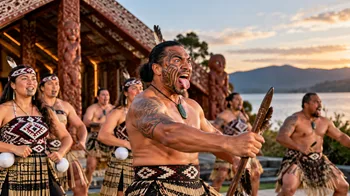
Māori celebrations are famous worldwide for their powerful haka performances, traditional songs, dances, ancestral customs, distinctive clothing, feasts and expressions of community identity.
These celebrations are not simply entertainment. They preserve Māori history, spirituality, family connections, respect for ancestors and the relationship between people and nature.
1. How to pronounce Māori
Māori - MAH-aw-ree
The word Māori has two main syllables, Mā-o-ri often represented as three vowel sounds in careful pronunciation. The macron (ā) indicates a long vowel.
The word Māori can mean ordinary or normal in te reo Māori, and it is also the name used for the Indigenous people of New Zealand and their language.
It is important to distinguish Māori culture from the haka, which is one particular form of traditional performance, rather than the name for every Māori celebration.
2. Who are the Māori people ?
Māori are the Indigenous Polynesian people of New Zealand. Their ancestors travelled across the Pacific Ocean in ocean-going canoes, known as waka, and settled in New Zealand centuries before European colonization.
Māori society developed its own language, traditions, governance structures, artistic practices and spiritual beliefs.
Important elements of Māori identity include:
- Whānau: Extended family and close family relationships.
- Hapū: Subtribe or kinship group.
- Iwi: Tribe or larger kinship group.
- Mana: Authority, prestige and standing.
- Manaakitanga: Hospitality, care and respect for others.
- Whakapapa: Genealogy and ancestral connections.
- Tikanga: Customs, values and appropriate cultural practices.
Māori celebrations often bring these values together through collective performances, storytelling, remembrance and hospitality.
3. What is the Haka ? The most famous Māori performance
The haka is one of the most internationally recognized Māori cultural traditions.
It is a powerful ceremonial performance involving rhythmic body movements, stamping, chanting, vocal expressions and coordinated gestures.
Although the haka is frequently associated with warriors preparing for battle, it has a much broader cultural purpose.
Why is the haka performed ?
Haka may be performed to:
- Welcome important guests and visiting groups.
- Honor respected individuals and ancestors.
- Celebrate weddings, birthdays and achievements.
- Express grief during funerals and memorial ceremonies.
- Demonstrate unity, courage, pride and determination.
- Motivate athletes before major sporting events.
Why do performers make fierce facial expressions ?
During certain haka, performers use intense facial expressions, wide eyes, strong gestures and sometimes the protrusion of the tongue.
These movements can express strength, determination, challenge and emotional intensity. Their meaning depends on the particular haka and its context.
The haka in international cricket and rugby
The New Zealand national rugby union team, the All Blacks, has made the haka internationally famous by performing it before matches.
The team's best-known haka is Ka Mate, traditionally attributed to the Ngāti Toa chief Te Rauparaha.
The haka is not exclusively a sports performance, however, and its cultural importance extends far beyond the playing field.
4. What is Matariki, the Māori New Year ?
Matariki is one of the most important annual celebrations associated with Māori culture.
It marks the Māori New Year for many iwi and is connected with the reappearance of the Matariki star cluster, known internationally as the Pleiades, in the winter sky.
Matariki is traditionally a time for remembering those who have died, celebrating the present and preparing for the future.
It became an official New Zealand public holiday in 2022.
How do people celebrate Matariki ?
Families and communities gather to share food, sing traditional songs, tell stories, remember loved ones and express gratitude.
Some communities hold special dawn ceremonies called hautapu, involving ceremonial offerings associated with the stars.
Different iwi follow different customs. Some communities use the star Puanga rather than Matariki as a seasonal marker.
5. Traditional Māori welcoming ceremony: Pōwhiri
A pōwhiri is a formal Māori welcoming ceremony, often conducted on a marae, a traditional communal meeting place.
The ceremony establishes relationships between hosts and visitors and demonstrates hospitality and mutual respect.
A pōwhiri can include an initial call of welcome (karanga), a ceremonial challenge (wero), formal speeches (whaikōrero), songs (waiata), the presentation of a gift (koha) and greetings such as the hongi, where people gently press noses.
The exact order and protocol vary between marae and iwi.
6. Māori traditional music, dance and clothing
Traditional Māori celebrations often feature kapa haka, a collective performing art that combines songs, chants, movement and haka.
Other important cultural expressions include poi, a performance using balls attached to cords, and waiata, traditional and contemporary songs.
Traditional garments may include woven cloaks known as kākahu and skirts called piupiu, made from prepared plant fibers.
Tā moko, traditional Māori tattooing, is another important expression of identity, ancestry and cultural heritage. It should not be regarded simply as decorative body art.
7. Traditional Māori food and celebrations
Food plays an important role in Māori gatherings, particularly in expressing manaakitanga, the value of caring for and welcoming others.
One of the best-known traditional cooking methods is hāngī, in which food is cooked using heat from stones in an earth oven.
Common foods can include meat, kūmara (sweet potato), potatoes and other vegetables.
Sharing food after a ceremony also helps strengthen relationships between guests and hosts.
8. Why Māori celebrations are important today
Māori celebrations continue to serve several important purposes: protecting te reo Māori (the Māori language), passing cultural knowledge to younger generations, maintaining ancestral relationships and strengthening community identity.
Major cultural events such as Te Matatini showcase Māori performing arts, while Matariki brings Māori traditions into wider national life.
In 2026, the Matariki theme Herenga Waka emphasized connection and bringing people together.
Māori celebrations represent far more than colourful performances or traditional dances. They are expressions of identity, ancestral knowledge, hospitality, remembrance and community.
From the powerful haka to the reflective traditions of Matariki, Māori cultural practices connect the past with the present while preserving traditions for future generations.
Understanding the difference between Māori, haka, pōwhiri and Matariki helps visitors and readers appreciate the depth and diversity of New Zealand's Indigenous culture.
Comments
0