

1. What is Jat-Jatin Dance ?
Jat-Jatin is a traditional folk dance and narrative performance from the Mithila cultural region, which extends across parts of northern Bihar in India and the adjoining Terai region of Nepal.
The dance centres on two characters, Jat and Jatin, who represent a husband and wife or a couple whose relationship is tested by separation and hardship. Through movements, gestures, songs and sometimes theatrical elements, performers communicate emotions that include love, longing, sadness, playful arguments and hope.
The performance is particularly known for portraying the difficulties faced by families when a husband leaves his village to earn a living elsewhere. This makes the dance an important expression of rural society, migration and family relationships.
2. Origin and history of Jat-Jatin Dance
Jat-Jatin developed within the folk traditions of Mithila and North Bihar, where oral storytelling, seasonal songs and community performances have long been important parts of cultural life.
The tradition is closely connected with village life and the experiences of ordinary people. Its stories have been passed down through folk songs and performances rather than through a single documented origin or a known founding artist.
The central narrative revolves around the lives of Jat and Jatin. Their relationship reflects the difficulties of poverty, separation and the struggle to maintain family bonds under challenging circumstances. Over time, the performance has also become a means of expressing broader social concerns.
Traditional accounts associate the dance with moonlit nights during the monsoon, when women and young people gathered in village courtyards to sing and perform. Different communities may preserve different versions of the dance, including versions with more emphasis on romantic storytelling or seasonal and ritual elements.
3. Where is Jat-Jatin Dance performed ?
The dance is primarily associated with the following regions:
- Mithila: A major cultural region of North Bihar known for its distinctive language, folk music, painting and traditional performing arts.
- Koshi region: Another important area of North Bihar where Jat-Jatin is a recognised folk tradition.
- Neighbouring parts of Nepal: Related traditions are also found in the Mithila and Terai cultural belt across the border.
The dance is especially significant in rural communities, where folk performances help preserve local stories, music and cultural identity.
4. The story of Jat and Jatin
The traditional narrative of Jat-Jatin revolves around the love and hardships of a couple whose lives are shaped by poverty, separation and difficult circumstances.
The story can be understood through the following stages:
- Love and companionship: Jat and Jatin represent a couple whose relationship is filled with affection, emotional attachment and everyday disagreements.
- Separation for livelihood: Jat leaves home to earn money, reflecting the circumstances that force rural workers to migrate in search of employment.
- Sorrow and longing: Jatin experiences the pain of separation and expresses her emotions through gestures, songs and dance movements.
- Conflict and hardship: The narrative may portray misunderstandings, domestic quarrels and difficulties faced by the couple. Some traditional versions also include a dramatic episode involving a boatman.
- Hope and reunion: The story expresses the desire for happiness, togetherness and a better future despite the hardships of life.
The details vary between versions, but the underlying message remains the importance of love, endurance and human relationships. The dance also uses humor and gentle teasing to show how people cope with adversity.
5. Main themes of Jat-Jatin Dance
The dance is more than a form of entertainment. Its themes reflect the social and emotional realities of rural life.
- Love and marital relationships : The interaction between Jat and Jatin expresses affection, companionship, playful arguments and the challenges of married life.
- Migration and separation : The departure of a husband in search of work highlights the emotional cost of migration and the difficulties faced by families left behind.
- Poverty and rural hardship : The performance portrays economic difficulties and the struggle to maintain a household in challenging circumstances.
- Community and seasonal life : Its association with the monsoon and village gatherings connects the performance with local customs, shared emotions and the rhythms of rural life.
These themes are documented in descriptions of the dance published by the Government of Bihar and cultural organizations.
6. Costumes worn during Jat-Jatin Dance
The traditional costumes are intended to reflect the rural setting and help audiences recognize the characters.
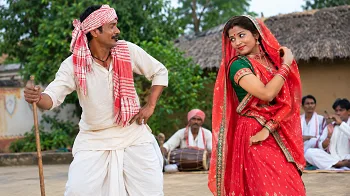
- Jatin's costume: A traditional sari, often worn with the pallu covering the head, along with bangles and other simple ornaments.
- Jat's costume: Traditional rural clothing, such as a dhoti and kurta, sometimes accompanied by a gamchha or headcloth.
- Facial expressions and makeup: Performers use expressions and, in some versions, masks or theatrical makeup to distinguish characters and communicate emotions.
- Props: A scarf or dupatta may be used expressively to convey sorrow, longing or separation.
Costumes can vary depending on the village tradition, troupe and whether the performance is presented in a traditional setting or on a modern cultural stage. Elaborate costumes and heavy jewelry are not essential features of every version.
7. Music and musical instruments
Music is central to the Jat-Jatin performance. Folk songs narrate the story, while rhythmic accompaniment helps dancers coordinate their movements.
- Dholak : A hand-played percussion instrument that provides the rhythmic foundation for singing and dance.
- Manjira : Small metal cymbals used to mark the beat and support the rhythm.
- Bansuri and other folk instruments : A flute or other regional instruments may accompany the singing, depending on the local performance tradition.
The most important musical element is the singing of regional folk songs, which communicates the characters' emotions and the meaning of the story. Instrumentation varies from one performance to another.
8. When and how is Jat-Jatin Dance performed ?
Traditionally, Jat-Jatin is associated with the rainy season, particularly moonlit nights during the monsoon months.
In some communities, women and young girls gather in open courtyards to sing and dance late into the night. Other versions feature a pair of performers enacting Jat and Jatin, with supporting singers and musicians.
A typical performance may include:
- Folk singing to establish the story and rhythm.
- Expressive gestures representing love, separation and domestic disagreements.
- Rhythmic steps and coordinated movements between the characters.
- Dramatic sequences that communicate hardship and longing.
- A conclusion expressing hope, resilience or reconciliation.
Today, the dance may also be presented at cultural festivals, educational programmes and stage events. Modern performances can be shorter and more choreographed than traditional village gatherings.
9. Cultural and social significance
Jat-Jatin is important because it preserves the lived experiences and cultural identity of communities in North Bihar.
Preservation of folk heritage: The dance keeps traditional songs, local expressions and storytelling techniques alive across generations.
Representation of women's experiences: The character of Jatin provides a way to express loneliness, longing and the emotional challenges faced by women when family members migrate for work.
Social commentary: Through humor, arguments and sadness, the performance addresses poverty, family relationships and other everyday difficulties.
Community participation: Traditional gatherings bring people together through singing, dancing and shared storytelling.
Connection with the monsoon: Its seasonal associations reflect the importance of rainfall and agricultural rhythms in rural life.
Together, these features make Jat-Jatin a valuable part of Bihar's intangible cultural heritage.
10. Difference between Jat-Jatin and other folk dances of Bihar
| Folk dance | Main characteristic |
|---|---|
| Jat-Jatin | Portrays a couple's relationship, separation, poverty and rural life. |
| Jhinjhia | A traditional women's dance associated with prayers for rainfall during droughts. |
| Jharni | A ritual performance associated with Muharram and rhythmic bamboo sticks. |
| Jhumeri | A folk dance from Mithilanchal associated with seasonal and community celebrations. |
| Bidesia | A folk theatre and dance-drama tradition associated with migration and social issues in the Bhojpuri-speaking region. |
These forms illustrate the diversity of Bihar's folk culture, with each tradition having its own regional associations, themes and performance practices.
11. Interesting facts about Jat-Jatin Dance
- It is one of the best-known folk dances of North Bihar.
- It is especially associated with the Mithila and Koshi regions.
- Its central characters are Jat and Jatin, representing a couple facing life's difficulties.
- The monsoon season and moonlit village gatherings are important elements of its traditional performance context.
- It combines storytelling, music, dance and theatrical expression.
- It reflects themes of migration, poverty, love, separation and resilience.
- The tradition has been passed down through community practice and oral transmission.
The Government of Bihar specifically identifies Jat-Jatin as a prominent folk dance of North Bihar and highlights its portrayal of migration, poverty and the relationship between husband and wife.
12. Frequently asked questions (FAQs)
Q1. Jat-Jatin is the folk dance of which state ?
Jat-Jatin is a famous folk dance of Bihar, particularly the Mithila and Koshi regions of North Bihar.
Q2. What is the main theme of Jat-Jatin Dance ?
Its main theme is the relationship between Jat and Jatin, including love, separation, domestic disagreements, poverty and the challenges of rural life.
Q3. During which season is Jat-Jatin traditionally performed ?
It is traditionally associated with the monsoon season, often on moonlit nights.
Q4. Which musical instruments are used in Jat-Jatin Dance ?
The dholak and other rhythmic instruments may accompany the folk singing. Manjira and flute can also feature, depending on the local performance.
Q5. Who performs Jat-Jatin Dance ?
Traditional versions include women performing in groups and versions in which a pair of performers enact the characters of Jat and Jatin. The format varies by locality and performance setting.
Q6. Why is Jat-Jatin Dance important ?
It preserves Bihar's folk heritage while expressing rural life, family relationships, migration, hardship and the resilience of ordinary people.
Q7. Is Jat-Jatin a classical or folk dance ?
It is a folk dance and narrative performance, not a classical dance form.
Jat-Jatin is much more than a traditional dance of Bihar. It is a cultural expression of love, separation, economic hardship and hope, shaped by the everyday experiences of rural communities. Through folk songs, rhythmic movements and expressive storytelling, the dance preserves the traditions of Mithila and the Koshi region while communicating emotions that remain relevant today.
Its continued performance helps protect Bihar's rich cultural heritage and ensures that the stories, music and experiences of earlier generations are passed on to future audiences.
Also Read :
Comments
0