



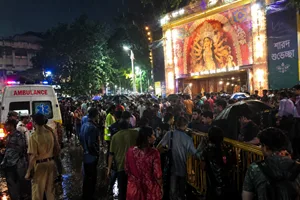
A tragic stampede at the Chorbagan Sarbojanin Durga Puja pandal in North Kolkata has claimed at least 19 lives and left around 25 people injured, according to reports published on October 18, 2026. The incident occurred on Saturday evening, October 17, amid heavy rain and a large gathering of devotees and Durga Puja visitors.
The tragedy has raised serious concerns about crowd management, emergency exits, security arrangements and public communication at large religious gatherings. Authorities have launched an investigation to establish the sequence of events and determine whether lapses in safety arrangements contributed to the loss of life.
Kolkata Stampede 2026: Key Highlights
Particular | Details |
|---|---|
Incident | Kolkata Durga Puja stampede |
Date | October 17, 2026 |
Location | Chorbagan Sarbojanin Durga Puja pandal, North Kolkata, West Bengal |
Reported deaths | At least 19 |
Reported injured | Around 25 |
Festival | Durga Puja |
Suspected contributing factors | Heavy rain, crowd surge, inadequate crowd control and confusion |
Investigation | Police investigation and a state-announced Special Investigation Team (SIT) |
Status | Investigation ongoing as of October 18, 2026 |
Figures and investigation details reflect news reports available on October 18, 2026, and may be revised as authorities release further information.
What Happened in the Kolkata Stampede?
The incident took place at the Chorbagan Sarbojanin Durga Puja pandal, a community festival venue in North Kolkata. Large numbers of people had gathered to visit the pandal during Durga Puja, one of West Bengal's most important annual festivals.
According to preliminary reports, heavy rain prompted people to move towards the pandal and its covered areas. The crowd became difficult to control, and a sudden surge caused people to fall. Confusion over crowd movement and announcements reportedly worsened the situation.
Police accounts reported on October 18 also pointed to narrow access routes, inadequate security personnel and shortcomings in entry-and-exit arrangements. Investigators are examining the evidence to establish precisely how the crowd surge developed.
The incident demonstrates how a crowded public gathering can quickly become dangerous when weather conditions, restricted movement and inadequate crowd-control measures combine.
Death Toll and Injuries
The reported death toll rose as authorities continued assessing the consequences of the disaster. By October 18, multiple news outlets were reporting at least 19 deaths and approximately 25 injured people. The injured were taken to hospitals, including Kolkata Medical College and Hospital, for treatment.
The tragedy has left families grieving and renewed concerns about whether sufficient precautions were taken to protect visitors at a high-footfall festival venue.
Authorities may revise the casualty figures as the investigation and medical assessments progress.
What Caused the Kolkata Stampede?
The exact sequence of events remains under investigation. However, preliminary police accounts and media reports have identified several possible contributing factors.
1. Heavy Rainfall and Sudden Crowd Movement
Rain reportedly prompted visitors to move towards the pandal and seek shelter, increasing pressure around already crowded areas.
2. Narrow Entrances and Exits
Preliminary police statements identified narrow gates and approach roads as potential bottlenecks that restricted people's movement.
3. Inadequate Crowd Management
Police reportedly raised concerns about the number of police personnel and private security guards deployed at the venue.
4. Confusing Announcements
Reports indicate that an announcement suggesting the pandal structure might collapse may have caused additional panic. Investigators are examining who made the announcement and why.
These are preliminary findings and reported contributing factors, not a final determination of legal responsibility.
Government Response and Investigation
Following the tragedy, authorities initiated steps to investigate the incident and examine the safety arrangements at the venue.
Special Investigation Team: The state government announced a special investigation to examine the circumstances surrounding the stampede.
Questioning and detentions: Police detained or questioned festival organizers, private security personnel and other staff as part of the investigation. Reports published on October 18 differed on the number of people detained or arrested.
Forensic examination: Forensic teams visited the site, and investigators began examining CCTV footage, witness accounts and the venue's arrangements.
Crowd restrictions: Authorities advised some heavily visited Durga Puja venues to temporarily suspend public entry or strengthen crowd-control measures.
The investigation is expected to examine whether the venue's capacity, entry and exit arrangements, staffing and emergency response were adequate.
Compensation Announced for Victims
Reports published on October 18 described compensation measures announced following the tragedy.
Authority | Reported assistance |
|---|---|
Prime Minister's Office | ₹2 lakh for the next of kin of each deceased person and ₹50,000 for injured victims |
West Bengal government | ₹25 lakh and a Group D government job for the family of each deceased victim, according to reports |
These figures reflect the announcements reported by news outlets. Families should confirm eligibility, documentation and payment procedures through the relevant government authorities.
Why Is the Kolkata Stampede a Serious Concern?
Durga Puja attracts large numbers of visitors to temporary pandals across Kolkata. During the festival, popular attractions can experience substantial surges in footfall, particularly in the evening and during periods of adverse weather.
A stampede or crowd crush does not necessarily require people to run. When too many people are packed into a confined space, pressure can build until individuals lose control of their movement. If several people fall, those behind them may be unable to stop or move away.
Crowd-safety experts identify excessive crowd density, narrow passageways, poorly coordinated entry and exit routes, and inadequate communication as significant risk factors.
The Kolkata incident underlines the importance of preventive planning rather than relying solely on emergency response after a crowd becomes dangerous.
Important Safety Lessons for Durga Puja Organizers
To reduce the risk of similar disasters, organizers and authorities should consider the following measures:
Control the number of visitors: Establish safe capacity limits and temporarily stop entry when the venue reaches capacity.
Provide separate entry and exit routes: Avoid situations where incoming and departing visitors compete for the same narrow passage.
Increase trained security personnel: Deploy sufficient police and private security staff at gates, approach roads and other bottlenecks.
Prepare for bad weather: Establish clear procedures for managing visitors during heavy rain, lightning or other emergencies.
Use clear public announcements: Communicate verified information through loudspeakers, signage and trained staff to prevent rumors and confusion.
Maintain emergency access: Keep routes clear for ambulances, firefighters and rescue personnel.
Monitor crowd density: Use CCTV, observation teams and coordinated control rooms to identify dangerous congestion early.
Conduct emergency drills: Ensure organizers, police, medical teams and volunteers know how to respond to a sudden crowd surge.
The central lesson is that crowd safety depends on coordinated planning, controlled movement and clear communication.
Kolkata Stampede: What Happens Next ?
As of October 18, 2026, the investigation remains ongoing. The immediate priorities are providing medical care to injured people, supporting affected families, preserving evidence and determining the circumstances that led to the crowd surge.
The findings of the investigation will be important in establishing whether safety failures occurred and what measures should be taken to prevent similar tragedies at future public gatherings.
The incident also serves as a reminder that festival celebrations must be supported by effective crowd-management systems. The safety of devotees and visitors should remain the foremost responsibility of organizers and public authorities.





Comments
0