






1. Ayodhya Ram Mandir: Important facts
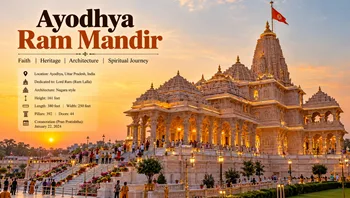
| Particulars | Details |
|---|---|
| Official name | Shri Ram Janmabhoomi Mandir |
| Location | Ayodhya, Uttar Pradesh, India |
| Main deity | Lord Ram in his child form, Ram Lalla |
| Religious tradition | Hinduism |
| Temple architecture | Traditional Nagara Style |
| Consecration date | January 22, 2024 |
| Foundation ceremony | August 5, 2020 |
| Managing authority | Shri Ram Janmabhoomi Teerth Kshetra Trust |
| Temple height | 161 feet |
| Temple length | 380 feet |
| Temple width | 250 feet |
| Number of pillars | 392 |
| Number of doors | 44 |
| Main entrance | Eastern side, through Singh Dwar |
| Entry fee | Free general darshan |
The temple's architectural specifications were detailed in official information released by the Prime Minister's Office.
2. Why is Ayodhya considered the birthplace of Lord Ram ?
Ayodhya is one of the seven sacred cities, collectively known as the Sapta Puri, in Hindu religious tradition.
According to the Ramayana, Lord Ram was born in Ayodhya to King Dasharatha and Queen Kaushalya. He belonged to the Suryavansha, or Solar Dynasty, and is revered as Maryada Purushottam, meaning the ideal person who upholds righteousness, moral responsibility and duty.
The Ramayana describes Ayodhya as the capital of the ancient kingdom of Kosala, ruled by King Dasharatha.
Lord Ram's life is associated with important moral and spiritual teachings, including:
- Dharma (righteousness and moral duty).
- Satya (truthfulness and honesty).
- Compassion, humility and respect for others.
- Responsibility towards family and society.
- Justice, sacrifice and ethical leadership.
The concept of Ram Rajya comes from the idealized reign of Lord Ram, symbolizing a society governed by justice, prosperity and concern for the welfare of its people.
For devotees, the Ram Janmabhoomi Temple is therefore much more than a religious structure. It is a sacred place connected with Lord Ram's birth and spiritual legacy.
3. Complete history of Ayodhya Ram Mandir
The history of the Ram Janmabhoomi site involves religious beliefs, historical structures, archaeological investigations, political movements and decades of litigation.
Ancient religious significance
Ayodhya has been associated with Lord Ram for centuries through the Ramayana, the Puranas and other Hindu religious literature.
Hindu tradition identifies Ayodhya as Lord Ram's birthplace, although specific claims about the site's earliest structures must be distinguished from archaeological and documentary evidence.
The Babri Masjid and historical dispute
The Babri Masjid stood at the disputed site for centuries. Historical accounts generally date its construction to the 16th century, during the reign of the Mughal emperor Babur.
Hindu and Muslim communities advanced competing claims over the site, and the dispute became particularly prominent during the colonial period.
Major historical developments
| Year | Important event |
|---|---|
| 1528–1529 | Traditional dating of the construction of Babri Masjid |
| 1850s | Religious tensions and disputes over worship at the site intensified |
| 1885 | Mahant Raghubar Das filed a suit seeking permission to construct a temple at Ram Chabutra |
| 1949 | Idols of Ram Lalla were placed inside the mosque, leading to further legal disputes |
| 1986 | A court ordered the unlocking of the premises for Hindu worship |
| December 6, 1992 | Babri Masjid was demolished by a large mob |
| 2003 | Archaeological Survey of India conducted excavations under court direction |
| 2010 | Allahabad High Court ordered a three-way division of the disputed land |
| November 9, 2019 | Supreme Court delivered its final judgment in the title dispute |
| February 5, 2020 | Central government announced the Ram Janmabhoomi temple trust |
| August 5, 2020 | Bhoomi Pujan ceremony for the new temple |
| January 22, 2024 | Consecration of Ram Lalla in the new temple |
| June 2025 | Ram Darbar was unveiled and subsequently opened to devotees |
| November 25, 2025 | Ceremonial flag-hoisting at the temple |
The demolition of Babri Masjid in 1992 was unlawful and triggered widespread communal violence. The Supreme Court later addressed the destruction of the mosque and the 1949 placement of idols in its 2019 judgment.
4. Supreme Court's historic judgment in 2019
On November 9, 2019, a five-judge Constitution Bench of the Supreme Court of India delivered a unanimous judgment concerning the disputed land in Ayodhya.
The court awarded the disputed 2.77-acre site for the construction of a Ram temple through a government-established trust.
It also directed that an alternative five-acre plot be allotted to the Sunni Central Waqf Board for the construction of a mosque.
The court considered documentary records, evidence of worship, possession claims, archaeological findings and the applicable law. Its decision was a civil title judgment rather than a judicial determination of religious faith.
The judgment created the legal framework for the construction of the present Ram Mandir.
5. Bhoomi Pujan and construction of Ram Mandir
On August 5, 2020, Prime Minister Narendra Modi participated in the Bhoomi Pujan ceremony, marking the ceremonial beginning of construction.
The Shri Ram Janmabhoomi Teerth Kshetra Trust was entrusted with overseeing the temple's development.
The project brought together traditional stone-carving techniques, temple architectural knowledge and modern structural engineering.
The temple has been built using stone-based construction techniques, with an emphasis on durability and traditional architectural principles.
Important construction features
The temple incorporates:
- Carved sandstone architectural elements.
- A substantial foundation of roller-compacted concrete.
- A granite plinth designed to protect against ground moisture.
- Traditional interlocking stone construction techniques.
- Intricate sculptures of Hindu deities and sacred motifs.
- Facilities for water treatment, sewage management, electricity and fire safety.
According to the Prime Minister's Office, the temple's foundation includes a 14-metre-thick layer of roller-compacted concrete and a 21-foot-high granite plinth. The main temple construction avoids the use of iron.
6. Architecture and design of Ayodhya Ram Mandir
The Ram Mandir follows the traditional Nagara architectural style, widely associated with Hindu temples in northern India.
Its design emphasizes sculpted pillars, ornamental carvings, elevated platforms and prominent temple spires.
Five major mandaps
The temple features five important halls:
- Nritya Mandap: Associated with dance and artistic expression in traditional temple architecture.
- Rang Mandap: A ceremonial hall featuring elaborate architectural decoration.
- Sabha Mandap: A gathering hall within the temple.
- Prarthana Mandap: A hall associated with prayer and devotion.
- Kirtan Mandap: A hall associated with devotional singing and spiritual gatherings.
These halls form part of the temple's architectural arrangement and connect its sacred spaces.
7. Ram Lalla idol: The main attraction of the temple
The central deity of the Ram Mandir is Ram Lalla, representing Lord Ram in his childhood form. The main idol was sculpted by Karnataka-based artist Arun Yogiraj from dark stone.
The idol depicts a young Lord Ram standing gracefully, holding a bow and arrow.
Special features of the idol
- Approximately 51 inches tall.
- Represents Lord Ram as a young child.
- Made from dark stone.
- Decorated with traditional ornaments and religious symbols.
- Installed in the main sanctum sanctorum, known as the Garbhagriha.
The idol is considered sacred by devotees, who offer prayers seeking blessings, peace and spiritual strength.
8. Pran Pratishtha ceremony on January 22, 2024
The Pran Pratishtha ceremony was a major milestone in the temple's modern history.
The ceremony involved Vedic rituals, religious prayers and the consecration of the Ram Lalla idol.
Prime Minister Narendra Modi participated in the main ceremony, alongside religious representatives and invited dignitaries.
The event attracted nationwide attention and was watched by millions through television and digital broadcasts.
Temples, homes and public spaces across India marked the occasion with prayers, devotional songs, decorations and the lighting of lamps.
The ceremony symbolized the beginning of regular worship of Ram Lalla in the newly constructed sanctum.
9. Ram Mandir darshan timings and aarti schedule in 2026
The Shri Ram Janmabhoomi Teerth Kshetra Trust has announced revised winter timings effective November 1, 2026.
| Ceremony | Time |
|---|---|
| Temple opens | 04:00 AM |
| Temple closes | 10:00 PM |
| Mangala Aarti | 04:30 AM |
| Shringar Aarti | 06:30 AM |
| Public darshan begins | 07:00 AM |
| Raj Bhog Aarti | 12:00 PM |
| Afternoon darshan resumes | 01:35 PM |
| Sandhya Aarti | 07:00 PM |
| Shayan Aarti | 09:30 PM |
Until October 31, the previously announced temple opening and closing times remain 3:45 AM and 10:30 PM.
How to book Ram Mandir darshan
General darshan is free. The Trust also introduced Sugam Darshan and General Darshan passes in 2026 to help visitors access different parts of the complex.
According to an April 2026 announcement, a maximum of five devotees can be included on one pass.
For pass availability, use the Trust's booking portal: Shri Ram Janmabhoomi Online Booking Portal
10. Important festivals celebrated at Ram Mandir
Ram Navami
Ram Navami celebrates the birth of Lord Ram and is among the most important Hindu festivals observed in Ayodhya.
The occasion includes prayers, devotional singing, temple decorations and special worship.
One of the temple's notable features is the Surya Tilak, an arrangement designed to direct sunlight onto the forehead of Ram Lalla around midday on Ram Navami.
Deepotsav and Diwali
Ayodhya's Deepotsav celebrations attract attention for their elaborate lighting displays along the Sarayu River and Ram Ki Paidi.
Thousands of volunteers participate in arranging earthen lamps, while the city hosts religious and cultural programmes.
Diwali is associated in Hindu tradition with Lord Ram's return to Ayodhya after his exile and victory over Ravana.
Other religious occasions
The temple and the wider city also observe important Hindu festivals, including Hanuman Jayanti, Vijayadashami and various traditional religious celebrations.
11. Famous temples and tourist attractions near Ram Mandir
Hanuman Garhi
A prominent temple dedicated to Lord Hanuman. Many devotees visit Hanuman Garhi before proceeding to Ram Janmabhoomi.
Kanak Bhawan
A beautiful temple associated with Lord Ram and Goddess Sita, known for its ornate architecture and decorated idols.
Dashrath Mahal
A religious landmark traditionally associated with King Dasharatha, the father of Lord Ram.
Ram Ki Paidi
A series of ghats beside the Sarayu River, famous for devotional gatherings, evening views and Deepotsav celebrations.
Nageshwarnath Temple
A historic Shiva temple connected with traditions concerning Kush, the son of Lord Ram.
12. How to reach Ayodhya Ram Mandir
By Air
The nearest airport is Maharishi Valmiki International Airport, Ayodhya Dham, which connects Ayodhya with major Indian cities through scheduled services.
Travellers can hire a taxi or use local transport to reach the temple area.
By Train
Ayodhya Dham Junction and Ayodhya Cantt are important railway stations serving the city. Train connectivity is available through various routes linking Ayodhya with other parts of India.
By Road
Ayodhya is accessible by road from Lucknow, Varanasi, Prayagraj, Gorakhpur and other cities in Uttar Pradesh.
State transport buses, private buses, taxis and personal vehicles are commonly used.
13. Best time to visit Ayodhya
The most comfortable season for sightseeing is generally October to March, when temperatures are cooler than during the summer months.
Season Conditions October-March Generally pleasant for pilgrimage and sightseeing April-June Hot weather, with potentially extreme afternoon temperatures July-September Monsoon conditions, including rainfall and humidity
Major religious festivals attract larger crowds. Visitors planning a trip during Ram Navami or Diwali should arrange accommodation and transport in advance.
14. Important tips for visitors
Visitors should carry valid identification, dress respectfully and follow temple security instructions.
Large bags, electronic devices and other restricted belongings may need to be deposited outside the designated security area. Photography restrictions can apply within the temple complex.
Senior citizens and visitors with mobility needs should check current accessibility arrangements before arriving.
Since Ayodhya attracts substantial pilgrim traffic, allow extra time for security checks, queues and movement between religious sites.
15. Religious, cultural and economic importance
The Ram Mandir has significance across several dimensions.
Religious importance: It provides devotees with a major pilgrimage destination associated with Lord Ram and Hindu traditions.
Cultural importance: The temple showcases traditional Indian architecture, sculpture, craftsmanship and devotional practices.
Historical importance: Its development is connected with centuries of religious tradition and the modern history of India's legal institutions.
Economic importance: Pilgrimage tourism supports hotels, restaurants, transport operators, shops, guides, artisans and other businesses in Ayodhya. At the same time, growing visitor numbers create demands for infrastructure, waste management and crowd control.
Tourism importance: The temple has strengthened Ayodhya's position as a major destination for religious and cultural tourism.
16. Frequently asked questions
When was Ayodhya Ram Mandir inaugurated ?
The Pran Pratishtha ceremony was held on January 22, 2024.
Who manages Ram Mandir ?
The Shri Ram Janmabhoomi Teerth Kshetra Trust manages the temple.
Is Ram Mandir darshan free ?
Yes. General darshan is free, and the Trust provides free pass-based arrangements for certain visits and aartis.
Who made the Ram Lalla idol ?
The principal Ram Lalla idol was sculpted by Arun Yogiraj.
What is the architectural style of Ram Mandir ?
The temple follows the traditional Nagara style of northern Indian temple architecture.
Can tourists visit Ayodhya Ram Mandir throughout the year ?
Yes, subject to temple schedules, security arrangements and any temporary restrictions.
What is the best time to visit ?
October to March generally offers more comfortable weather for travel and sightseeing.
The Ayodhya Ram Mandir stands as a major religious and cultural landmark of modern India. Dedicated to Lord Ram, it brings together ancient Hindu traditions, elaborate temple architecture and contemporary engineering.
Its consecration in January 2024 marked a defining moment in the site's modern history, following decades of litigation and a Supreme Court judgment.
For devotees, the temple is a sacred destination for prayer and spiritual reflection. For visitors interested in history and architecture, it provides an opportunity to explore Ayodhya's religious heritage and the traditions that continue to shape the city.
Also Read :


Comments
0