







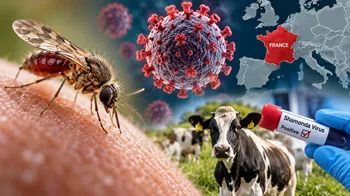
The development has prompted investigations by French health authorities, the World Health Organization (WHO), and the European Centre for Disease Prevention and Control (ECDC). However, scientists have emphasized that the discovery of a single human infection does not mean the virus is spreading widely among people.
According to French public health authorities, there is currently no evidence of human-to-human transmission or an identified health risk to the general population. Investigations are continuing to determine how the patient contracted the virus and whether the infection contributed to the death.
What is Shamonda Virus ?
Shamonda virus (SHAV) is a vector-borne virus belonging to the genus Orthobunyavirus, family Peribunyaviridae, and Simbu serogroup.
It is closely related to the Schmallenberg virus, another insect-transmitted pathogen associated with livestock diseases and reproductive complications.
The virus was first isolated from cattle in Nigeria in 1965. Over subsequent decades, researchers identified it in animals in parts of Africa and Asia, including Japan.
For many years, Shamonda virus was primarily regarded as an animal-health concern rather than a human infectious disease. That understanding changed in October 2026 following the confirmation of the first human infection in France.
Key facts about Shamonda virus
Feature Details Virus name Shamonda Virus (SHAV) Virus family Peribunyaviridae Genus Orthobunyavirus Serogroup Sibmu First identified Nigeria, 1965 Main animal hosts Cattle, sheep, goats and horses Primary transmission Bites from infected Culicoides midges First documented human case France, October 2026 Human-to-human transmission Not identified Specific vaccine None currently available Specifical antiviral treatment None established General public health risk No risk currently identified by French authorities
First Human Case of Shamonda Virus in France: What Happened ?
On October 22, 2026, French authorities publicly confirmed the first documented human infection involving Shamonda virus.
The patient had been receiving treatment at the Hospices Civils de Lyon hospital system and was severely immunocompromised, meaning the immune system was significantly less capable of fighting infections.
French authorities had been notified of the case on October 7, 2026.
Medical investigations detected the virus in several biological samples, establishing that the patient had been infected.
The patient also experienced serious neurological complications. Preliminary findings suggested that some brain-related symptoms were associated with the Shamonda virus infection.
The patient subsequently died in October.
However, an important distinction remains: the patient's death does not establish that Shamonda virus was the direct cause. Investigators are assessing its possible contribution alongside the patient's existing medical condition.
How did the patient become infected ?
The leading hypothesis is that the patient was bitten by an infected Culicoides midge in eastern France, where the virus had circulated among animals.
Investigators are examining the patient's environmental exposure, travel history, potential contact with animals, and possible exposure to insect vectors.
Other possible sources of infection have not been completely excluded.
French authorities are also conducting genomic sequencing and comparing the virus found in the patient with strains circulating in livestock.
These investigations could help scientists understand whether the infection resulted from an unusual exposure or whether the virus has a broader, previously unrecognized ability to infect humans.
How Does Shamonda Virus Spread ?
Shamonda virus is primarily transmitted through the bites of tiny blood-feeding insects known as Culicoides midges.
These insects can acquire the virus when feeding on infected animals and potentially transmit it during subsequent blood meals.
Understanding the transmission process
In animals, transmission from an infected mother to her developing fetus can also occur during pregnancy.
The virus is not known to spread directly from one animal to another through ordinary contact.
For humans, transmission through infected midges is suspected but has not yet been conclusively established. There is currently no evidence of person-to-person transmission.
Symptoms of Shamonda Virus in Humans
Because only one human infection has been documented, scientists do not yet have enough evidence to establish a reliable list of typical human symptoms.
In the French case, neurological complications were observed, including serious brain-related symptoms.
Reports described disturbances involving neurological function, but these findings cannot yet be treated as the standard clinical presentation of Shamonda virus infection.
Researchers still need to determine whether infection can cause mild symptoms, asymptomatic illness, or severe complications in people with otherwise healthy immune systems.
Possible neurological complications
The reported human case has raised questions about whether Shamonda virus can affect the central nervous system.
Potential areas of investigation include altered consciousness, confusion, and other neurological abnormalities. These are not yet established as common Shamonda virus symptoms.
Anyone experiencing sudden confusion, seizures, loss of consciousness, or other serious neurological symptoms should seek emergency medical attention, regardless of the suspected cause.
Shamonda Virus Symptoms in Cattle and Other Animals
Unlike human disease, the effects of Shamonda virus on livestock have been observed more extensively.
According to the World Organization for Animal Health (WOAH), reported signs include:
- Fever: Elevated body temperature during acute infection.
- Diarrhoea: Digestive disturbances, sometimes occurring suddenly.
- Lethargy: Reduced activity, weakness, or unusual tiredness.
- Reduced milk production: Significant economic concern for dairy farmers.
- Reproductive disorders: Abortions and other pregnancy-related complications have been reported.
- Congenital abnormalities: Developmental problems in offspring have been associated with infections involving this virus group.
Shamonda virus has also been detected in horses with neurological disorders, although the precise relationship between viral infection and particular clinical signs requires further investigation.
The severity and long-term impact of the variants circulating in Europe are not yet fully understood.
Shamonda Virus Outbreak in Europe in 2026
The emergence of Shamonda virus in Europe represents an important development in veterinary disease surveillance.
According to WHO, the virus was first detected in European cattle in June 2026, in southern Germany and Switzerland.
By October, infections had been reported in livestock across several European countries.
ECDC identified detections in Austria, Belgium, France, Germany, Ireland, Italy, Liechtenstein, Luxembourg, the Netherlands, Portugal, Spain, Switzerland, and Jersey.
In France alone, surveillance data indicated that by October 20, 2026, the virus had been detected in cattle in 52 administrative departments, with additional detections involving sheep and a horse.
Why is the European outbreak significant ?
Europe's livestock populations may have different levels of pre-existing immunity compared with animals in regions where Shamonda virus has circulated historically.
Scientists are also investigating the characteristics of two European variants identified as SHAV-EU1 and SHAV-EU2.
Their transmission patterns, potential effects on animal reproduction, and overall impact on agricultural production require further research.
In addition, midge activity is seasonal. European biting midges are generally more active during warmer months, although their activity depends on local environmental conditions.
Researchers are examining how changing temperatures, insect populations, animal movements, and surveillance practices influence the virus's distribution.
Is Shamonda Virus Deadly for Humans ?
At present, there is insufficient evidence to classify Shamonda virus as a highly fatal human pathogen.
The first documented human patient died, but that individual had a serious underlying illness and severe immune suppression.
Scientists have not established a human case-fatality rate, nor have they determined how frequently the virus might cause illness in otherwise healthy people.
The WHO and ECDC are monitoring developments, but neither the single case nor the livestock outbreaks provide evidence of a widespread human health emergency.
Is There a Vaccine or Treatment for Shamonda Virus ?
As of October 24, 2026, no specific vaccine or established antiviral treatment is available for Shamonda virus infection.
Medical care for a suspected human infection would therefore focus on supportive treatment, management of complications, and addressing underlying medical conditions.
For livestock, veterinary management may include supportive care, insect-exposure reduction, and monitoring affected herds.
Scientists need further studies before effective virus-specific medicines or vaccines can be developed and evaluated.
How Can Shamonda Virus Be Prevented ?
Because Shamonda virus is associated with biting midges, minimizing exposure to these insects is a reasonable precaution, especially in areas where infected livestock have been detected.
Preventive measures include wearing long-sleeved clothing outdoors, using appropriate insect repellents according to their instructions, and installing suitable insect screens where practical.
Livestock owners should work with veterinarians to monitor unexplained fever, sudden decreases in milk production, and reproductive problems in their animals.
These precautions are based on the known role of biting midges in animal transmission. Their effectiveness in preventing human Shamonda virus infection has not yet been directly established.
Is Shamonda Virus a Threat to India ?
Shamonda virus has historically been identified in animals in Africa and parts of Asia. However, the discovery of a human infection in France does not establish that a human outbreak is occurring in India.
There is currently no evidence from the reviewed WHO and European public health reports indicating widespread human transmission.
For India, the main considerations would be veterinary surveillance, monitoring insect-borne livestock diseases, and evaluating any future findings reported by health authorities.
There is no scientific basis at present for describing Shamonda virus as an emerging human epidemic in India.
What Are WHO and European Health Authorities Doing ?
Following the French case, international and national public health organizations have begun coordinating surveillance and scientific investigations.
The main priorities include understanding the infection route, improving laboratory diagnostic methods, examining viral genetic characteristics, identifying any additional human cases, and evaluating the implications for livestock health.
The ECDC is also working with European partners to strengthen testing capacity and support investigations.
The response follows a One Health approach, recognizing the connections between human health, animal health, and environmental conditions.
Frequently Asked Questions About Shamonda Virus
1. What is Shamonda virus?
Shamonda virus is an insect-borne virus that mainly infects livestock, including cattle, sheep, goats, and horses.
2. Where was Shamonda virus first discovered?
It was first isolated from cattle in Nigeria in 1965.
3. Has Shamonda virus infected humans?
Yes. France confirmed the first documented human infection in October 2026.
4. Can Shamonda virus spread from person to person?
There is currently no evidence of human-to-human transmission.
5. What are the symptoms of Shamonda virus in humans?
Typical symptoms remain unknown. The first documented patient experienced serious neurological complications while also suffering from a severe underlying illness.
6. Is there a Shamonda virus vaccine?
No specific vaccine is currently available.
7. Is Shamonda virus more dangerous than COVID-19?
There is no evidence supporting such a comparison. Only one human Shamonda virus infection has been documented, and its broader effects on human health remain uncertain.
8. Should people be worried about a new pandemic?
Current evidence does not suggest an imminent pandemic. Health authorities are monitoring the virus because its ability to infect humans is not yet fully understood.
The confirmation of the first human Shamonda virus infection in France marks an important development in infectious disease research.
Although the virus has circulated among animals for decades, its detection in a human patient raises new questions about cross-species transmission and the potential health consequences for vulnerable individuals.
However, the available scientific evidence does not justify widespread alarm.
The French patient had a severely compromised immune system, and investigations into the infection and death are ongoing. No human-to-human transmission has been identified, and public health authorities have not identified a risk to the general population.
Continued surveillance, veterinary research, and international cooperation will be essential to understanding Shamonda virus and determining whether it poses any broader threat to human health.
Also Read :




Comments
0